She/Her | Postdoctoral Research Associate
Current Research

Benthic production model
Modeling benthic production on a sand shoal in the Gulf of Mexico
Sand shoals off the coast of Louisiana are relic barrier islands that were once formed by the Mississippi River when it flowed through a different channel. The sediment content of these shoals is very similar to present-day barrier islands, which makes them a resource for sands for coastal restoration. The impacts of dredging on these sand shoals is not well understood. Using data collected in Phase I of this project, I am working to build a benthic production model that will remotely predict production of benthic microalgae via satellite light and ocean color data. This research is funded by the Bureau of Ocean Energy Management under cooperative agreement M19AC00015.
Past Work

Food web modeling
Oceanic Gulf of Mexico food web model
The oceanic Gulf of Mexico is a dynamic and complex ecosystem that is currently not well understood, especially at depths greater than 200m. This food web model aimed to capture the vertical connectivity of the water column in the oceanic Gulf, with a particular focus on deep sea organisms. The model platform, parameters, and scenarios are available at the publication link below. This collaborative project is funded through GoMRI grant #G231805.
Scyphozoans in Food Webs

Contribution of jellyfish to food webs
Scyphozoan jellyfish, along with other gelatinous zooplankton have been underrepresented in food web models and diet studies. Once believed to be trophic dead ends, recent research has shown that jellyfish contribute to the diets of many marine organisms. An interesting aspect of gelatinous zooplankton biology is the tendency to form large aggregations of individuals called blooms, which are influenced by biological, environmental, and even climatological factors. The boom and bust nature of blooms complicates how gelatinous zooplankton are modeled as well as how they impact their environment. With this project, I examined how fluctuations in jellyfish biomass affect oceanic food webs as well as quantified particulate mucus production of jellyfish and how it contributes to carbon cycling in the water column.


Master's Thesis
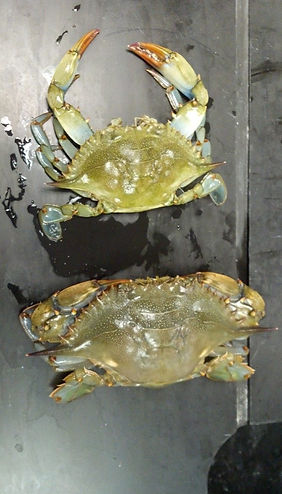
Analysis of exoskeletal content and epidermal enzymatic activity during the molting cycle of the blue crab, Callinectes sapidus
Blue crabs, along with all other crustaceans, must shed or molt their rigid exoskeleton in order to grow and reproduce. The old exoskeleton has to be broken down in preparation for the new exoskeleton. In this project, I examined how that degradation occurs. I measured the amounts of exoskeletal inorganic salts, proteins, and chitin and compared them to measurements of enzymatic activity in the epidermis immediately underlying the exoskeleton. The enzymes measured corresponded to each type of exoskeletal component and allowed us to hypothesize the order in which each component is broken down and if the enzymes may be under the control of molting hormones.